It’s surprisingly easy to write an optimal implementation of Levenshtein-based typo-tolerant search. You basically need to:
- Tokenize documents.
- Create an inverted index to quickly look up documents from terms.
- Combine a trie with an adaptation of the usual Levenshtein distance algorithm for typo-tolerant search with optimal time complexity O(
#termsxmax_levenshtein_distance).
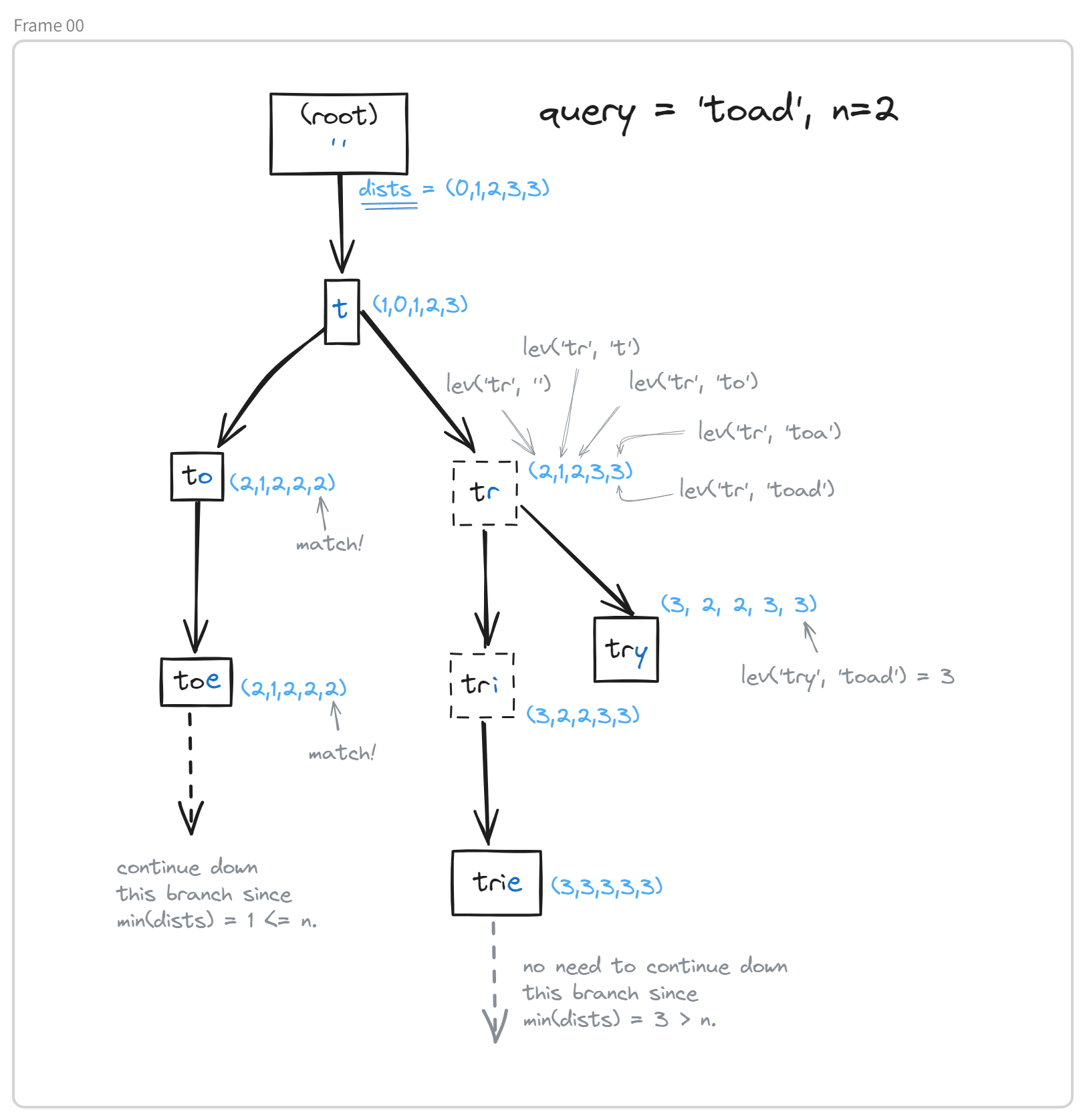
At the core of this implementation is the algorithm for fuzzy searching the trie, which is a variation of the algorithm used to compute the Levenshtein distance. It’s a depth first search of the trie:
- At each node, we associate a vector
distssuch thatdist[i]represents the Levenshtein distance betweenquery[:i]and the word represented by the current node. - By capping the maximum Levenshtein distance at
n, this computation can be performed with2*n+1time complexity using the parent node’sdistsvector. - Furthermore, the
distsvector allows for both (1) determining the Levenshtein distance between the query and the current word, and (2) checking whether or not descendants of the current node could potentially match. So we’re both effieciently computing the Levenshtein distance and only exploring relevant branches of the trie.
Here’s what the trie and the attached dists vectors might look like:
Code
import string
from collections import defaultdict


class Node:
    def __init__(self, word="", parent=None):
        self.word = word
        self.parent = parent
        self.children = defaultdict()
        self.dists = None
        self.is_word = False


class Trie:
    def __init__(self):
        self.root = Node()

    def preprocess(self, doc):
        return (
            doc.lower()
            .translate(str.maketrans("", "", string.punctuation))
            .encode("ascii", "replace")
            .decode()
        )

    def insert(self, word):
        word = self.preprocess(word)
        node = self.root
        for i, char in enumerate(word):
            node = node.children.setdefault(char, Node(word[: i + 1], node))
        node.is_word = True

    def fuzzy_search(self, query, n):
        query = self.preprocess(query)
        matching_set, visited, stack = set(), set(), [self.root]
        while stack:
            node = stack.pop()
            if node not in visited:
                node.dists = self.get_levenshtein_dists(node, query, n)
                if node.is_word and node.dists[-1] <= n:
                    matching_set.add(node.word)
                if min(node.dists) <= n:
                    stack.extend(node.children.values())
        return matching_set

    def get_levenshtein_dists(self, node, query, n):
        if node.parent is None:
            return range(len(query) + 1)
        dists = [n + 1] * (len(query) + 1)
        dists[0] = len(node.word)
        prev_dists = node.parent.dists
        for i in range(max(0, dists[0] - n - 1), min(len(query), dists[0] + n + 1)):
            dists[i + 1] = (
                prev_dists[i]
                if query[i] == node.word[-1]
                else 1 + min(prev_dists[i], prev_dists[i + 1], dists[i])
            )

        return dists


class Index:
    def __init__(self, documents):
        self.trie = Trie()
        self.inverted_index = defaultdict(lambda: set())
        for doc in documents:
            for word in self.trie.preprocess(doc).split():
                self.trie.insert(word)
                self.inverted_index[word].add(doc)

    def fuzzy_search(self, query, n):
        return {
            doc
            for word in self.trie.fuzzy_search(query, n)
            for doc in self.inverted_index[word]
        }
Example
from simplesearch import Index

docs = [
    "Wikipedia is hosted by the Wikimedia Foundation, a non-profit organization that also hosts a range of other projects.",
    "The Hrabri class consisted of two submarines built for the Kingdom of Serbs, Croats and Slovenes. The first submarines to serve in the Royal Yugoslav Navy (KM), they arrived in Yugoslavia on 5 April 1928, and participated in cruises to Mediterranean ports prior to World War II."
    "Did you know that Jean-Emmanuel Depraz (pictured) won a Magic: The Gathering world championship using three cards depicting the player who beat him in 2021?"
]

index = Index(docs)
index.fuzzy_search("Willipedia", 2)
## {'Wikipedia is hosted by the Wikimedia Foundation, a non-profit organization that also hosts a range of other projects.'}
Notes
- This demo is only optimized for time complexity, not memory.
- Obviously this not a refined search engine. It’s just efficient single-term fuzzy search and corresponding document lookup.
References
- http://blog.notdot.net/2010/07/Damn-Cool-Algorithms-Levenshtein-Automata
- https://julesjacobs.com/2015/06/17/disqus-levenshtein-simple-and-fast.html
- https://blog.mikemccandless.com/2011/03/lucenes-fuzzyquery-is-100-times-faster.html
Reuse
Copyright
Olivier Binette